Sonnet 91
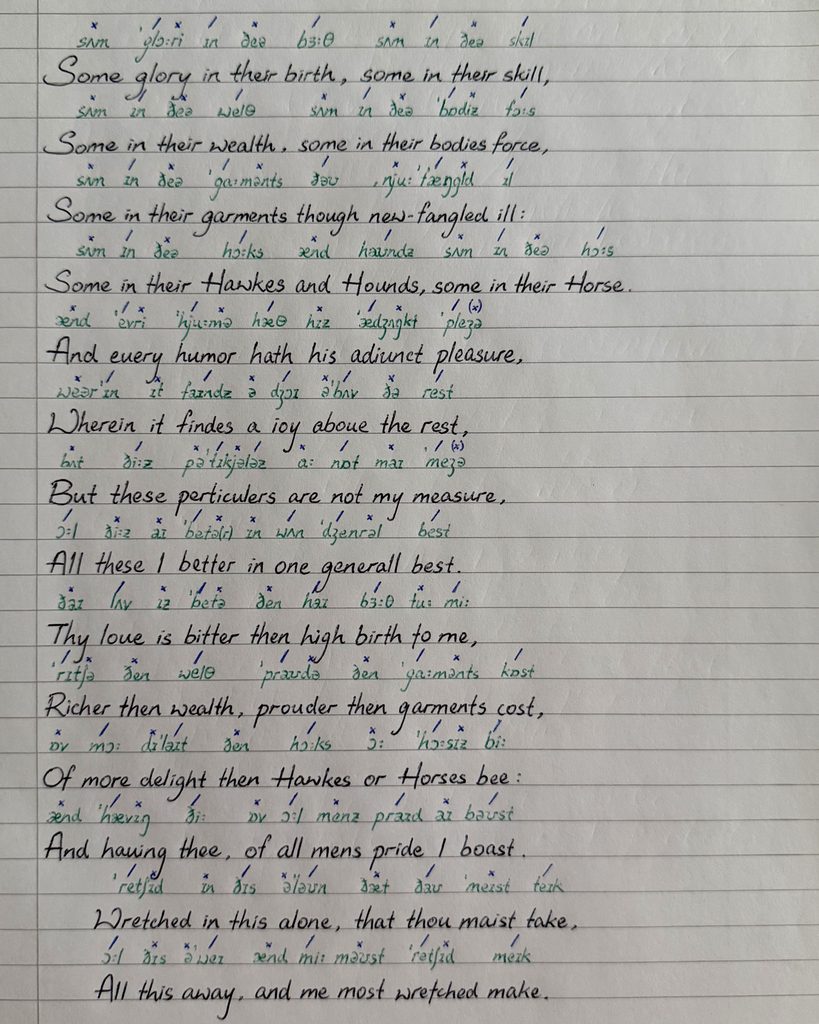
Text: William Shakespeare, Shake-speares Sonnets, 1609 Quarto. IPA: Oxford Learner’s Dictionaries. Annotations and photo: Lokky Lau.
WHAT I NOTICED
L1 to L4: ‘Some glory in their birth’ makes me think of royals immediately. The sonnet seems to give birth, skill, wealth, strength and status considerable value and respect, before suggesting that what is to come is worth even more.
L1 to L4: The repeated stress on ‘in’ also catches my attention. The first four lines follow the iambic pentameter quite closely, almost as though Shakespeare is setting the scene and establishing the norm.
L5 and L7: Both lines have feminine endings, ‘pleasure’ and ‘measure’. The extra unstressed syllable makes the rhythm feel slightly less settled to me. It feels like a bridge towards what the speaker really wants to say.
L7: I particularly like the word ‘perticulers’ here. It sums up everything mentioned before: birth, skill, wealth and so on, yet most of its vowel sounds are schwas, which makes the word feel quite muted to me. It makes me wonder if the things listed before are already losing their weight.
L8: I like the contrast between ‘all’ and ‘one’, and ‘better’ and ‘best’. The shift in rhythm also catches my attention. It feels like the speaker is breaking away from the pattern he has established.
L9: ‘Thy love’ is the subject of the whole sonnet, yet this is the only time it is pronounced.
L9 to L11: These three lines echo the qualities mentioned in L1 to L4, comparing ‘thy love’ against them: better, richer, prouder and of more delight. Each comparison seems to climb towards L12.
L11 to L12: I noticed that nine of the ten metrical stresses in these two lines fall on long vowels or diphthongs. This makes the lines feel more sustained to me. I want to relish them rather than rush through them.
L13 to L14: Both lines begin with trochaic inversions. To me, this makes the possibility of losing ‘thy love’ feel completely out of the norm.
MY READING
lokkylau.com · hello@lokkylau.com
© 2026 Lokky Lau · Privacy Policy