Sonnet 138
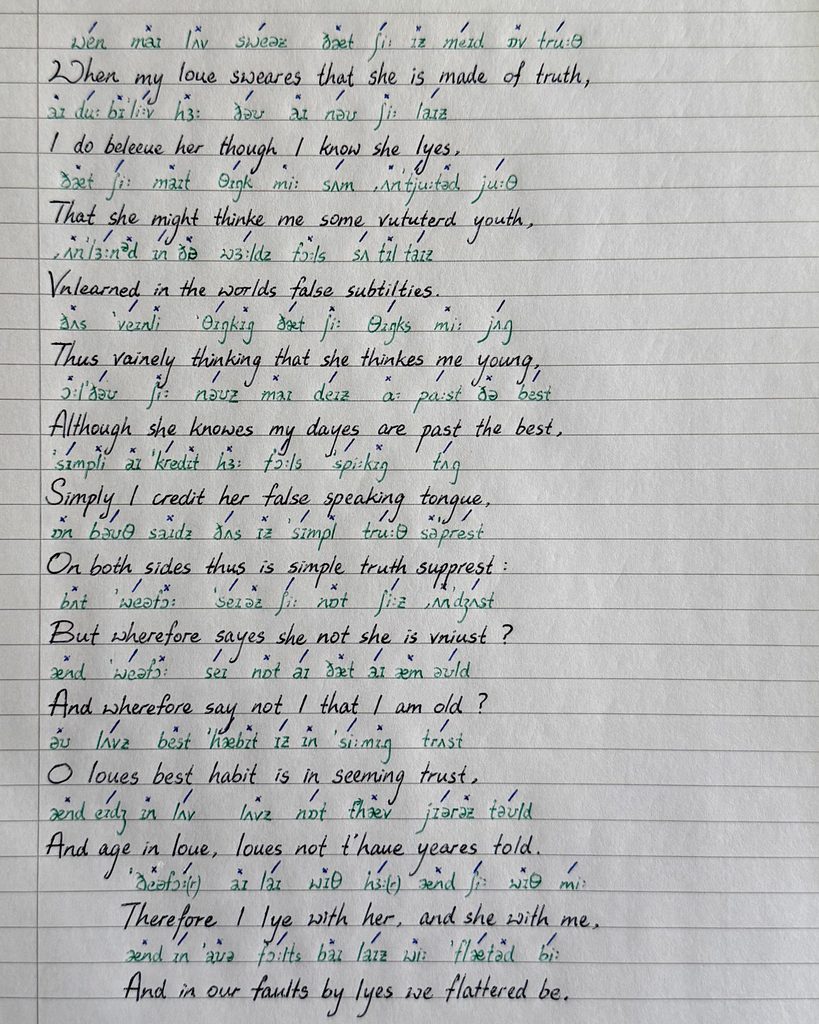
Text: William Shakespeare, Shake-speares Sonnets, 1609 Quarto. IPA: Oxford Learner’s Dictionaries. Annotations and photo: Lokky Lau.
WHAT I NOTICED
L1: The stresses on ‘When my love sweares’ can fall on ‘my’ and ‘sweares’ (two iambs), ‘love’ and ‘sweares’ (a spondee), or ‘When’ and ‘sweares’ (an inversion). I’ve settled on the inversion as it serves as a hook and starts the sonnet with a symbolic contradiction, paving the way for what is to come.
L2: I like this line a lot. Although ‘I do beleeve her’ and ‘I know she lyes’ sound contradictory, I think they can both be true at the same time. Therefore, I would not overplay the seeming contradiction but instead let the words do the work. I like that the word ‘lyes’ has a double meaning: one being not telling the truth, the other being sleeping with someone.
L4: I’ve decided to pronounce ‘Vnlearned’ as ‘Vnlearnèd’ so that the extra syllable ‘nèd’ is available to complete the iambic pentameter of the line.
L4: The closest modern alternative for ‘subtilties’ is ‘subtleties’. However, by pronouncing ‘subtleties’ /ˈsʌtəltiːz/, the rhyme between L2 and L4 is lost. I believe Shakespeare intended the rhyme to be heard, so I’ve decided to pronounce it as /ˈsʌtɪltaɪz/ to maintain the rhyme with ‘lyes’ /laɪz/.
L7: Apart from the first foot of this sonnet, the rhythm for L1 to L6 follows the iambic pentameter closely. L7 breaks this pattern by starting with ‘Simply’. The trochaic opening gives the line a more immediate, conversational quality to me, as though the speaker is brushing aside what he has just admitted.
L9 to L10: Since the speaker is emphasising the parallel between ‘she’ and ‘I’, and highlighting how they both suppress the truth, I’ve decided to pronounce ‘sayes’ with two syllables, /ˈseɪəz/, and shorten ‘she is’ to one syllable, /ʃiːz/, so that the two lines are rhythmically parallel.
L12: I’ve decided to pronounce ‘yeares’ as ‘yearès’ so that the extra syllable ‘rès’ is available to complete the iambic pentameter of the line.
L13 to L14: I enjoy the couplet. The sonnet’s been separating ‘she’ and ‘her’ from ‘I’ and ‘my’, while these two lines bring them together through ‘with’, ‘we’ and ‘our’. It feels like acceptance and resolution to me. I want this to be reflected in the regularity of the iambic pentameter, so I’ve decided to stress the second syllable of ‘Therefore’ instead of the usual stress on ‘There’. This sonnet reminds me of a modern-day scenario where a married couple is asked, ‘What’s the secret to a long-lasting marriage?’ and the husband answers, ‘She’s always right.’
MY READING
lokkylau.com · hello@lokkylau.com
© 2026 Lokky Lau · Privacy Policy